Assisted living laws and licensing in North Carolina: what families should know
By Rod Burnett · Updated 2026-07-22
This is general information about how assisted living is regulated in North Carolina, not legal advice. For a specific situation involving a facility dispute or a legal question, consult an elder law attorney or contact the state regulatory agency directly.
Who licenses and regulates facilities
In North Carolina, assisted living facilities operate under an adult care home license issued and enforced by the NC Division of Health Service Regulation (DHSR), part of the state Department of Health and Human Services. This license authorizes a facility to provide residential long-term care, supervision, and assistance with daily living activities to adults who can’t fully live independently. Memory care units typically operate under an additional special care unit designation within that same licensing structure, reflecting the added requirements for secured, dementia-specific care.
What licensing actually requires
Licensed facilities are subject to standards covering staffing levels, staff training, building safety, medication management procedures, resident rights, and food service. DHSR conducts periodic inspections, called surveys, to check compliance, and facilities found in violation can face corrective action plans, fines, or in serious cases, license suspension or revocation.
This matters for families because licensing isn’t just a formality; it’s the mechanism that sets a floor for safety and care quality across every facility in the state. A facility operating without a current, valid license is a serious red flag that shouldn’t be overlooked, regardless of how the physical space or staff present on a tour.
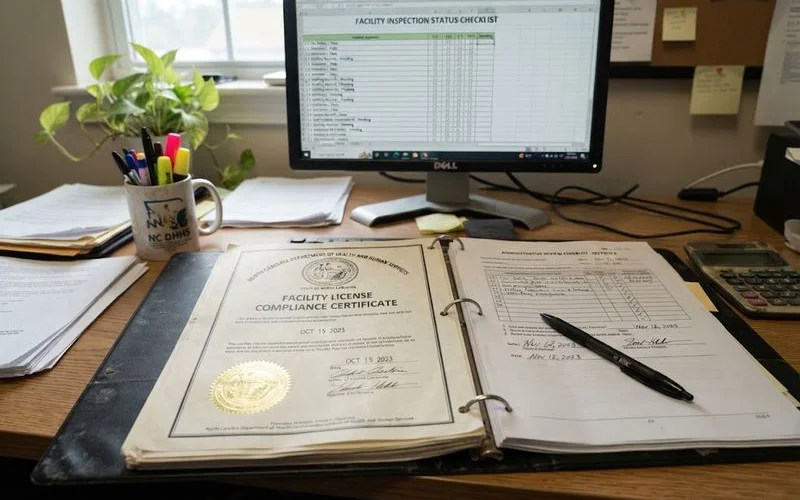
How to check a facility’s licensing and inspection history
Inspection results are public record in North Carolina. Before touring or committing to a facility, it’s worth asking to see the facility’s current license displayed on-site, and separately requesting or looking up its recent inspection history through DHSR. A pattern of repeated, serious violations is meaningfully different from a single minor citation, so read the actual findings rather than just noting that a violation occurred at some point.
| What to check | Where to look |
|---|---|
| Current license status | Posted on-site, or DHSR licensing records |
| Recent inspection results | DHSR public inspection database or by request |
| History of complaints or violations | DHSR complaint investigation records |
| Special care unit designation, if memory care is needed | Facility license documentation |
What the law covers, and what it doesn’t
Licensing regulation sets minimum standards, not a guarantee of excellence. A facility can be fully licensed and compliant while still not being the best fit for a particular resident’s needs or a family’s expectations around warmth, communication, or specific programming. Licensing tells you a facility meets the state’s baseline for safety and operation; it doesn’t tell you whether the staff are especially attentive or whether the culture feels right for your family. Both matter, and neither substitutes for the other.
Resident agreements and the law
Every licensed facility is required to provide a written resident agreement outlining services, fees, and discharge conditions before admission. This document is legally binding, and North Carolina law requires certain disclosures within it, including discharge and transfer policies. Reading it closely, and asking questions about anything unclear, is one of the most concrete legal protections a family has going into a placement.
Where to get more help
If you have specific concerns about a facility’s compliance, DHSR accepts complaints directly and has investigative authority. For broader legal questions, particularly around contracts, Medicaid eligibility, or resident rights disputes, an elder law attorney licensed in North Carolina is the appropriate resource, since regulations and case law shift over time and a guide like this one can’t substitute for current legal counsel.
Our Charlotte assisted living directory lists licensed facilities across the metro area, and our methodology explains how we verify and score them. Understanding the regulatory framework behind a facility’s license is one more layer of confidence when comparing options.
FAQ
- Who regulates assisted living facilities in North Carolina?
- The NC Division of Health Service Regulation (DHSR), within the state Department of Health and Human Services, licenses and inspects adult care homes and assisted living facilities across the state.
- Are assisted living inspection reports public?
- Yes. Inspection and survey results for licensed facilities are public record and can typically be requested from DHSR, and some are available through the state's online licensing databases.
- What's the difference between an adult care home license and a nursing home license?
- An adult care home license covers residential care with personal assistance, like most assisted living facilities. A nursing home license covers skilled nursing facilities, which provide licensed medical care, a different regulatory category entirely.
- What should I do if I suspect a licensing violation at a facility?
- Complaints can be filed directly with DHSR, which has authority to investigate and take enforcement action, including fines or license revocation for serious or repeated violations.